
What does “fragrance” really mean on a beauty label? Learn what may be hiding behind this single ingredient and how to make more informed personal care choices.
Have you ever turned over your favorite lotion, body wash, perfume, or self-tanner and spotted one seemingly simple ingredient:
Fragrance.
Or perhaps parfum.
It sounds straightforward. But “fragrance” doesn't necessarily represent one ingredient.
In the United States, individual ingredients used to create a fragrance generally do not have to be individually identified on a cosmetic ingredient label. Instead, the mixture can simply appear as “fragrance.”
That's important for consumers trying to make informed decisions about the products they use every day.
And during Breast Cancer Awareness Month, it's an especially important conversation because scientists continue to study how certain environmental exposures, including some endocrine-disrupting chemicals found in consumer products, may affect hormone health and breast cancer risk.
Let's unpack what “fragrance” actually means, what the science tells us, and some simple ways to reduce unnecessary chemical exposure without becoming afraid of your beauty routine.
What Does “Fragrance” Mean on a Skincare Ingredient Label?
Under U.S. cosmetic labeling regulations, most cosmetic ingredients must be individually listed.
Fragrance is different.
The FDA explains that individual fragrance ingredients may be listed collectively on a cosmetic label simply as “Fragrance.”
That means consumers can't necessarily determine every ingredient contained within a fragrance mixture just by reading the package.
And fragrance formulations can be complex.
The International Fragrance Association's 2025 Transparency List includes 3,691 ingredients currently used by the global fragrance industry, including 3,312 fragrance ingredients and 379 functional ingredients used to support fragrance formulations.
This doesn't mean your lotion contains 3,691 chemicals, or that every fragrance ingredient is harmful.
It means fragrance formulators have a very large palette of possible ingredients available to create individual scents.
And without full fragrance disclosure, consumers may not always know exactly which ones are present.
Is Fragrance in Skincare Bad for You?
Not necessarily.
“Fragrance” does not automatically mean toxic.
Fragrance mixtures may contain natural or synthetic ingredients, and many fragrance ingredients are used safely in consumer products.
The concern is that some fragrance formulations can also contain chemicals associated with health concerns, including allergens and certain chemicals with endocrine-disrupting properties.
Breast Cancer Prevention Partners reports that fragrance mixtures can contain dozens of individual ingredients and recommends choosing fragrance-free products or companies committed to greater fragrance ingredient transparency as one way to reduce exposure to chemicals of concern.
The bigger issue is therefore not simply:
“Fragrance = bad.”
It's:
Do you know what's actually in the fragrance you're using?
Can Fragrance Contain Phthalates?
Some fragrance formulations can contain certain phthalates.
Phthalates are a large group of chemicals used for different purposes in consumer products. Some are used as solvents or stabilizers in fragrances and personal care products.
Why have they received so much attention?
Certain phthalates have been identified as endocrine-disrupting chemicals, meaning they can interfere with normal hormone signaling.
Because hormones play an important role in breast tissue and many breast cancers are hormone-sensitive, researchers continue investigating environmental exposures that may influence hormonal pathways.
That doesn't mean using a fragranced body lotion causes breast cancer.
It means reducing unnecessary exposure to endocrine-disrupting chemicals is one reasonable component of a broader approach to reducing environmental exposures.
What Other Ingredients Can Be Found in Fragrance?
Depending on the formulation, a fragrance mixture may contain ingredients that create the scent itself as well as functional ingredients that help dissolve, stabilize, preserve, or extend it.
These can include:
Fragrance compounds that create floral, citrus, woody, vanilla, musk, or other scent profiles.
Solvents and diluents that help fragrance ingredients blend into a formulation.
Stabilizers and antioxidants that help maintain the fragrance over time.
Natural extracts and essential oils, which can also contain naturally occurring fragrance allergens.
Certain phthalates, which may be used as solvents or stabilizers in some fragrance formulations.
It's also important to understand that natural doesn't automatically mean safer.
Natural fragrance ingredients and essential oils can cause irritation or allergic reactions in some people, too.
That's why transparency…not simply whether something is labeled “natural” or “synthetic” matters.
What Are Endocrine-Disrupting Chemicals?
Endocrine-disrupting chemicals, or EDCs, are substances that can interfere with the body's hormone system.
They aren't found only in cosmetics.
People can encounter endocrine-disrupting chemicals through plastics, food packaging, household products, pesticides, personal care products, and the broader environment.
Scientists are particularly interested in cumulative exposure, the many small exposures we experience repeatedly throughout our lives.
This is an important distinction.
The goal isn't to become fearful of one application of perfume or lotion.
It's to ask:
Where can I reasonably reduce exposures I don't need?
Your daily personal care routine is one place where you have choices.
Does Fragrance Increase Breast Cancer Risk?
Breast cancer is a complex disease influenced by many factors, including age, genetics, reproductive and hormonal factors, alcohol consumption, physical activity, body weight, radiation exposure, and environmental factors.
However, researchers continue studying certain chemicals found in consumer products because of their carcinogenic or endocrine-disrupting properties and their potential relationship to breast health.
That's why Breast Cancer Awareness Month shouldn't only be about fear or even only about detection.
It can also be an opportunity for education and prevention-focused choices.
How Can You Avoid Hidden Fragrance Ingredients?
You don't have to overhaul your entire bathroom overnight.
Start with the products you use most frequently or apply over larger areas of your body.
Read Ingredient Labels
Look for the words “fragrance,” “parfum,” or “perfume.”
If they're present, see whether the company provides additional fragrance ingredient information on its website.
Look for Ingredient Transparency
Choose brands that clearly explain what they use to scent their products rather than relying solely on vague marketing terms.
Consider Fragrance-Free Products
If minimizing fragrance exposure is important to you, fragrance-free products are one of the simplest options.
And remember: “unscented” and “fragrance-free” don't always mean the same thing. Some products marketed as unscented may use fragrance ingredients to mask the natural odor of other ingredients.
Don't Assume “Natural” Means Safe
Essential oils and botanical extracts can be wonderful ingredients, but natural substances can also cause irritation and sensitization.
Look beyond the marketing claim and evaluate the actual ingredients.
Make One Swap at a Time
You don't need a perfect beauty routine.
Replace products as you use them up, prioritizing products you apply frequently and over larger areas of your body.
Reducing exposure is more realistic than trying to eliminate every chemical from your life.
A Simple Non-Toxic Self-Tanner Swap
Self-tanner is an interesting product to consider because it's typically applied over a large portion of the body and left on the skin for hours.
That's one reason ingredient transparency has always mattered to us at Elan Pure.
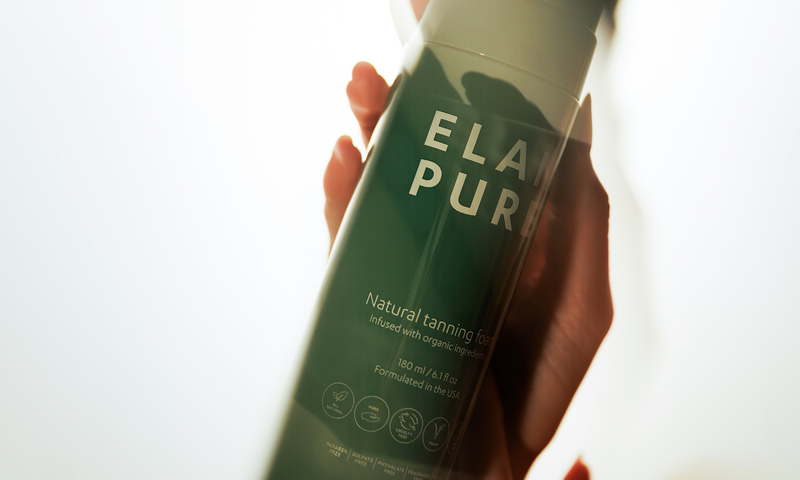
Our Self-Tanner is formulated without synthetic fragrance, parabens, phthalates, PEGs, synthetic dyes, or SLS.
And that delicious vanilla scent?
It isn't synthetic fragrance.
It's real vanilla extract.
Our formula combines plant-based DHA and organic erythrulose with skin-loving ingredients including glycerin, hyaluronic acid, cucumber, and calendula to create a beautiful, even, patch-free tan while supporting hydrated, healthy-looking skin.
Because we believe you should know what you're putting on your body.
Breast Cancer Awareness Starts With Better Questions
There is no single product swap that can prevent breast cancer.
And there is no such thing as living a completely “toxin-free” life.
But there is enormous value in becoming more informed about our everyday exposures.
Ask what's in your products.
Read labels.
Choose greater transparency.
Reduce unnecessary exposure where it's practical.
And don't let perfection become the enemy of progress.
Breast health isn't about being afraid of everything around us. It's about having the information to make more intentional choices for ourselves and our families.
Frequently Asked Questions
What does “fragrance” mean in skincare?
“Fragrance” or “parfum” can represent a mixture of multiple ingredients used to create or support a product's scent. In the U.S., individual fragrance ingredients generally don't have to be separately identified on cosmetic labels.
Can fragrance contain phthalates?
Yes. Certain phthalates may be used as solvents or stabilizers in some fragrance formulations, although not every fragrance contains phthalates.
Are essential oils safer than synthetic fragrance?
Not necessarily. Essential oils are natural, but some can cause irritation, allergic reactions, or skin sensitization. Ingredient transparency is more useful than relying solely on “natural” claims.
How can I reduce fragrance exposure?
Choose fragrance-free products or brands that disclose their fragrance ingredients, read labels, and prioritize swapping products you use frequently or apply over large areas of your body.
Choose Transparency. Make Informed Swaps.
You don't have to choose between beautiful results and being thoughtful about the ingredients you put on your body.
Know what's in your products. Reduce exposures where you can. And choose brands that believe you deserve to know what you're putting on your skin.
Discover Elan Pure's non-toxic, patch-free self-tanning routine made without synthetic fragrance, parabens, phthalates, PEGs, synthetic dyes, or SLS.
Shop the Elan Pure Glow Duo and discover the difference a non-toxic, hormone-safe, skincare-infused self-tanner can make. Glow safely, naturally, and confidently.
Save 10% Use Code Pinterest10